Tin (Sn) – Element 50
Tin is a chemical element with the symbol Sn (for Latin:stannum) and atomic number 50. It is a main group metal in group 14 of the periodic table. Tin shows a chemical similarity to both neighboring group-14 elements, germanium and lead, and has two possible oxidation states, +2 and the slightly more stable +4.
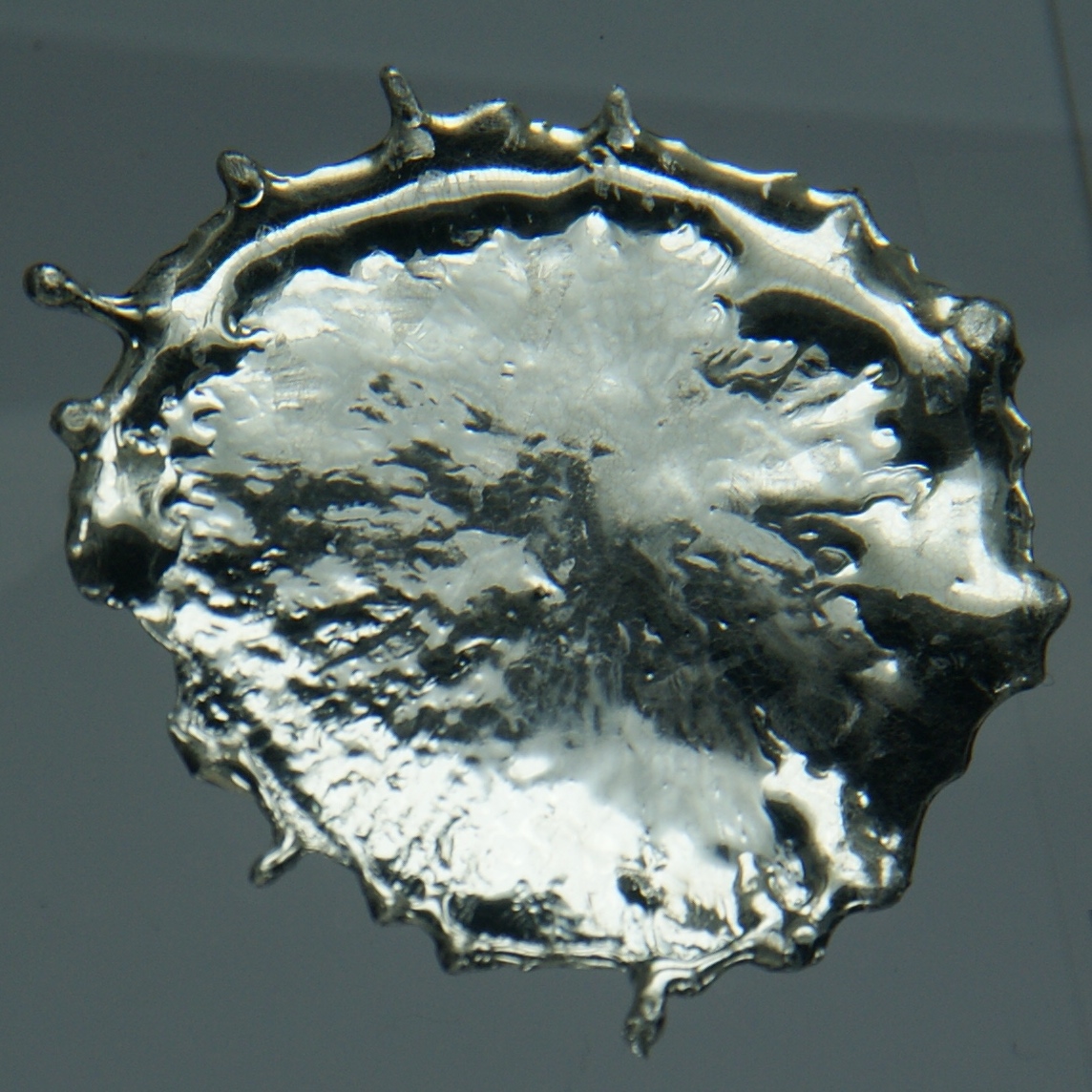
Tin facts and properties
- Atomic number
- 50
- Symbol
- Sn
- Atomic mass
- 118.7107 u
- Category
- Post-transition metal
- Group / period / block
- 14 / 5 / p-block
- State at room temperature
- Solid
- Appearance
- silvery-white (beta, β) or gray (alpha, α)
- Density
- 7.365 g/cm³
- Melting point
- 505.1 K (231.9 °C)
- Boiling point
- 2875 K (2601.9 °C)
- Electron configuration
- 1s2 2s2 2p6 3s2 3p6 4s2 3d10 4p6 5s2 4d10 5p2
- Electrons per shell
- 2, 8, 18, 18, 4
- Electronegativity (Pauling)
- 1.96
- Common oxidation states
- +4, +2
- Crystal structure
- body-centered tetragonal
- Magnetic ordering
- White (β): paramagnetic; gray (α): diamagnetic
- Radioactive
- No
- CAS number
- 7440-31-5
What is Tin used for?
Solder, tin plating for food cans, bronze and pewter.
Who discovered Tin and where does its name come from?
Discovered by unknown, before 3500 BC (protohistoric, around 35th century BC).
The name comes from a Proto-Germanic word. Its symbol Sn comes from the Latin name Stannum.
Tin questions and answers
What is Tin?
Tin is a chemical element with the symbol Sn (for Latin:stannum) and atomic number 50. It is a main group metal in group 14 of the periodic table. Tin shows a chemical similarity to both neighboring group-14 elements, germanium and lead, and has two possible oxidation states, +2 and the slightly more stable +4.
What is the atomic number, atomic mass and electron configuration of Tin?
Tin has atomic number 50 (50 protons), symbol Sn and atomic mass 118.7107 u. Its electron configuration is 1s2 2s2 2p6 3s2 3p6 4s2 3d10 4p6 5s2 4d10 5p2, with electrons arranged in shells as 2, 8, 18, 18, 4.
What is Tin used for?
Solder, tin plating for food cans, bronze and pewter.
Who discovered Tin?
Tin was discovered by unknown, before 3500 BC in protohistoric, around 35th century BC.
Where does the name Tin come from?
The name Tin comes from a Proto-Germanic word.
← IndiumOpen the interactive periodic tableAntimony →
Data: PubChem (NCBI, public domain) and Wikipedia (CC BY-SA). Photos: images-of-elements.com, CC BY 3.0.