Boron (B) – Element 5
Boron is a metalloid chemical element with symbol B and atomic number 5. Produced entirely by cosmic ray spallation and supernovae and not by stellar nucleosynthesis, it is a low-abundance element in both the Solar system and the Earth's crust. Boron is concentrated on Earth by the water-solubility of its more common naturally occurring compounds, the borate minerals.
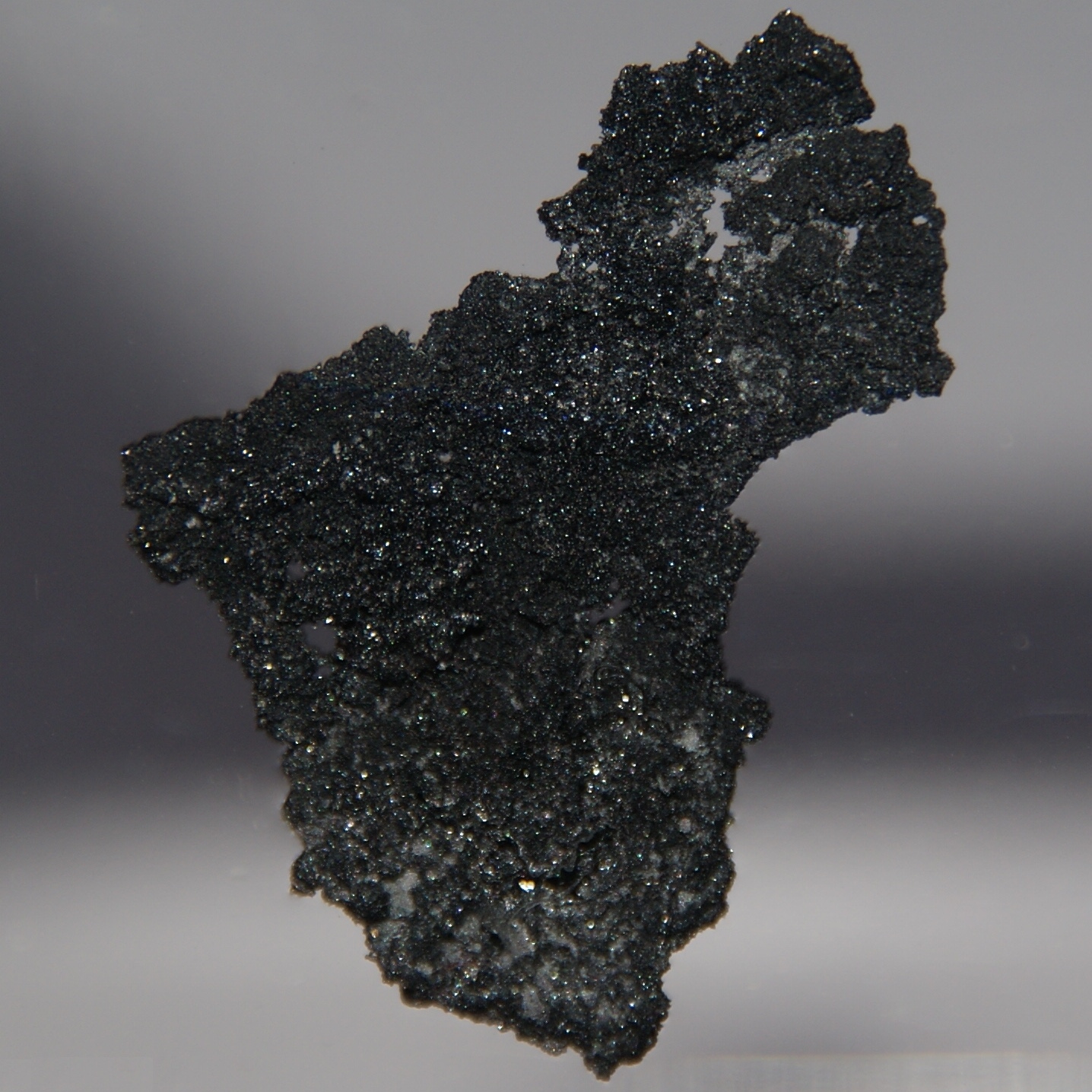
Boron facts and properties
- Atomic number
- 5
- Symbol
- B
- Atomic mass
- 10.81 u
- Category
- Metalloid
- Group / period / block
- 13 / 2 / p-block
- State at room temperature
- Solid
- Appearance
- black-brown
- Density
- 2.08 g/cm³
- Melting point
- 2349 K (2075.9 °C)
- Boiling point
- 4200 K (3926.9 °C)
- Electron configuration
- 1s2 2s2 2p1
- Electrons per shell
- 2, 3
- Electronegativity (Pauling)
- 2.04
- Common oxidation states
- +3
- Crystal structure
- rhombohedral
- Magnetic ordering
- Diamagnetic
- Radioactive
- No
- CAS number
- 7440-42-8
What is Boron used for?
Borosilicate glass, fibreglass insulation, detergents (borax), neutron absorbers in nuclear reactors and strong magnets (NdFeB).
Who discovered Boron and where does its name come from?
Discovered by Joseph Louis Gay-Lussac and Louis Jacques Thénard first isolated by Humphry Davy (30 June 1808).
The name comes from after borax, from which it was isolated; Ultimately from Arabic بَوْرَق (bawraq).
Boron questions and answers
What is Boron?
Boron is a metalloid chemical element with symbol B and atomic number 5. Produced entirely by cosmic ray spallation and supernovae and not by stellar nucleosynthesis, it is a low-abundance element in both the Solar system and the Earth's crust. Boron is concentrated on Earth by the water-solubility of its more common naturally occurring compounds, the borate minerals.
What is the atomic number, atomic mass and electron configuration of Boron?
Boron has atomic number 5 (5 protons), symbol B and atomic mass 10.81 u. Its electron configuration is 1s2 2s2 2p1, with electrons arranged in shells as 2, 3.
What is Boron used for?
Borosilicate glass, fibreglass insulation, detergents (borax), neutron absorbers in nuclear reactors and strong magnets (NdFeB).
Who discovered Boron?
Boron was discovered by Joseph Louis Gay-Lussac and Louis Jacques Thénard in 1808.
Is Boron magnetic?
No. Boron is diamagnetic, so it is very weakly pushed away by a magnet. You would not notice it in everyday life.
← BerylliumOpen the interactive periodic tableCarbon →
Data: PubChem (NCBI, public domain) and Wikipedia (CC BY-SA). Photos: images-of-elements.com, CC BY 3.0.