Lutetium (Lu) – Element 71
Lutetium is a chemical element with symbol Lu and atomic number 71. It is a silvery white metal, which resists corrosion in dry, but not in moist air. It is considered the first element of the 6th-period transition metals and the last element in the lanthanide series, and is traditionally counted among the rare earths.
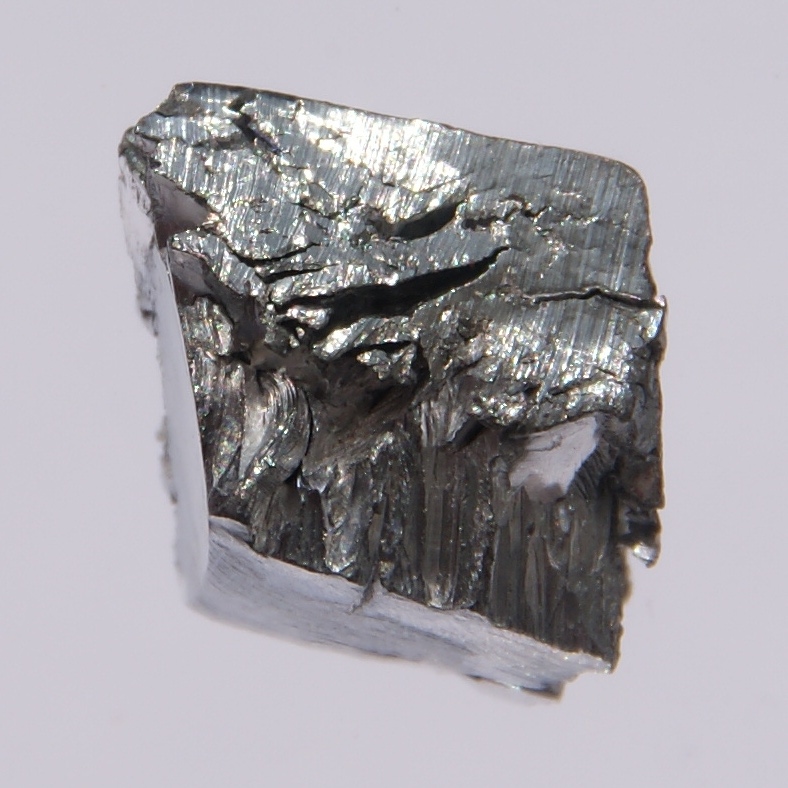
Lutetium facts and properties
- Atomic number
- 71
- Symbol
- Lu
- Atomic mass
- 174.9668 u
- Category
- Lanthanide
- Group / period / block
- 3 / 6 / d-block
- State at room temperature
- Solid
- Appearance
- silvery white
- Density
- 9.841 g/cm³
- Melting point
- 1925 K (1651.9 °C)
- Boiling point
- 3675 K (3401.9 °C)
- Electron configuration
- 1s2 2s2 2p6 3s2 3p6 4s2 3d10 4p6 5s2 4d10 5p6 6s2 4f14 5d1
- Electrons per shell
- 2, 8, 18, 32, 9, 2
- Electronegativity (Pauling)
- 1.27
- Common oxidation states
- +3
- Crystal structure
- hexagonal close packed
- Magnetic ordering
- Paramagnetic
- Radioactive
- No
- CAS number
- 7439-94-3
What is Lutetium used for?
PET scan detectors, petroleum-refining catalysts and cancer therapy (Lu-177).
Who discovered Lutetium and where does its name come from?
Discovered by Carl Auer von Welsbach and Georges Urbain (1906).
The name comes from after Lutetia, Latin for: Paris, in the Roman era.
Lutetium questions and answers
What is Lutetium?
Lutetium is a chemical element with symbol Lu and atomic number 71. It is a silvery white metal, which resists corrosion in dry, but not in moist air. It is considered the first element of the 6th-period transition metals and the last element in the lanthanide series, and is traditionally counted among the rare earths.
What is the atomic number, atomic mass and electron configuration of Lutetium?
Lutetium has atomic number 71 (71 protons), symbol Lu and atomic mass 174.9668 u. Its electron configuration is 1s2 2s2 2p6 3s2 3p6 4s2 3d10 4p6 5s2 4d10 5p6 6s2 4f14 5d1, with electrons arranged in shells as 2, 8, 18, 32, 9, 2.
What is Lutetium used for?
PET scan detectors, petroleum-refining catalysts and cancer therapy (Lu-177).
Who discovered Lutetium?
Lutetium was discovered by Carl Auer von Welsbach and Georges Urbain in 1907.
Is Lutetium magnetic?
Only very weakly. Lutetium is paramagnetic: it is pulled a tiny bit towards a magnet, far too little to feel with a fridge magnet.
← YtterbiumOpen the interactive periodic tableHafnium →
Data: PubChem (NCBI, public domain) and Wikipedia (CC BY-SA). Photos: images-of-elements.com, CC BY 3.0.